Glossary
Companies that prepare balance sheets are required to perform a cut-off inventory once a year. This gives them an overview of equipment, goods and material stocks. In practice, businesses use different methods to capture these assets.

The Topic in Brief
- A cut-off inventory helps companies meet legal requirements for stock recording.
- It usually coincides with the balance sheet date.
- Several practical methods are available, with physical inventory being the most important.
What Is a Cut-Off Inventory?
By definition, a cut-off inventory is an inventory count carried out on a specific date. The company wants to determine what its stock looks like at that point. Inventory can be determined at any time, but here the count is assigned to a specific reporting date. This often falls exactly on the balance sheet date or shortly before or after it.
Forms of Inventory Procedures
In practice, three forms of inventory are distinguished. A cut-off inventory is usually a physical inventory. However, book inventory and fixed asset inventory are also permitted as alternative methods.
Physical Inventory
This form of cut-off inventory records inventory quantities. In a physical inventory, goods and material stocks are the focus. The company records tangible assets and decides which capture method to use. Physical recording can be done by:
- Measuring
- Estimating
- Weighing
- Counting
For example, a manufacturing company or craft business may need to include screws, nails and similar materials in the inventory. Goods stored in the warehouse on the reporting date must also be recorded.
Book Inventory
While physical inventory focuses on tangible assets, book inventory records intangible assets and current assets. Accounting records make it possible to trace the relevant balances. Documents such as bank statements are important. Book inventory therefore covers all parts of inventory that cannot be captured physically, such as receivables and cash balances. Current bank balances are also relevant. Only the values as of the balance sheet date matter.
Fixed Asset Inventory
Fixed asset inventory covers movable fixed assets, such as machines or operating and office equipment. The company lists the relevant assets together in a fixed asset register. This register is continued according to business use. To determine the asset base, the company uses the continued acquisition costs. Fixed asset inventory is part of effective machine management.
Legal Basis for a Cut-Off Inventory
Businesses may be required to perform a stocktake or cut-off inventory. This applies to all companies that must prepare a balance sheet. In that case, inventory must be carried out once a year. In Germany, the relevant rules are found in §240 HGB and in the Fiscal Code.
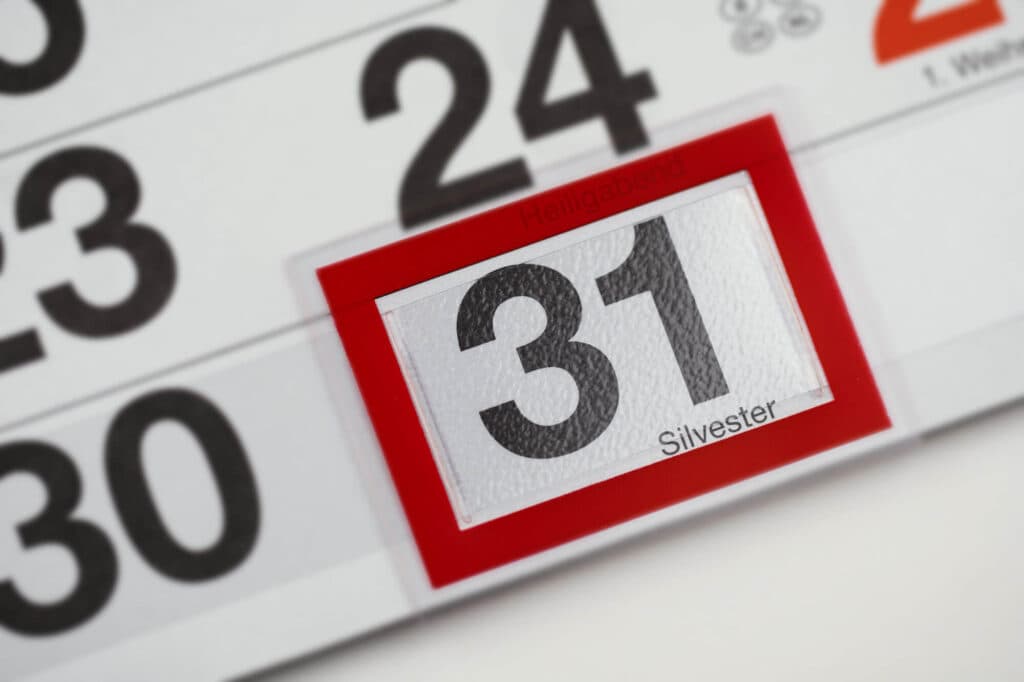
Companies are required to conduct inventory at the end of the financial year. Usually, cut-off inventory and balance sheet date coincide, often on December 31. This depends on the industry, however. In agriculture, for example, the calendar year and financial year may differ.
The law also provides some flexibility. Not every company can perform the inventory exactly on December 31 every year, so the count may also be carried out up to ten days before or after the reporting date.
How a Cut-Off Inventory Is Performed
To carry out a cut-off inventory, the company determines values for all goods and material stocks. Estimates are allowed if the values cannot be determined otherwise.
It is important that items are recorded twice. After the first count, a second person records everything again. An entry in the inventory is made only when both employees arrive at the same result. Otherwise, the physical inventory must be repeated.
Preparation Activities
For a physical inventory, management must first appoint an inventory manager. This person organizes the process, which is especially important in larger companies, and supervises the inventory.
Many companies use assistants because inventory work is often time-consuming. These helpers must be organized in good time.
Employees need suitable tools, such as measuring sticks, so they can count, measure and record items. The inventory manager provides these tools.
For book inventory, companies must record all relevant business transactions. This ensures a smooth process. It is important to keep all documents that make values traceable, especially:
- Account balances
- Receipts
- Invoices
- Balance and stock lists
- Receivables, liabilities and outstanding items with their amounts
Inventory Simplification Procedures
Overall, cut-off inventory is an involved process that can tie up company resources for many days. To reduce this burden, the law allows inventory simplification procedures. These include sample inventory, perpetual inventory and inventory performed before or after the reporting date. Our detailed article gives an overview of the individual inventory types. These methods can be used when needed to keep effort reasonable while still producing sufficiently accurate results.
Sample Inventory
Normally, cut-off inventory is a full inventory. The goal is to record all items or values completely. Sample inventory is different. Nevertheless, the company must follow the principles of proper accounting.
Mathematical and statistical procedures make it possible to extrapolate the total stock from a tested subset. The company records part of its stock and significantly simplifies the work. Large companies often use this method because complete recording can require extreme effort.
Perpetual Inventory
Companies may also conduct inventory continuously. In that case, the inventory is no longer tied to one reporting date. This does not mean that all required data is permanently available. Since the inventory is distributed throughout the year, the final result is available at the end. Values are determined in stages, for example by assigning product groups to individual months.
Inventory Before or After the Reporting Date
Another option is to carry out the inventory shortly before or after the balance sheet date. This is an inventory shifted before or after the reporting date. A specific deadline applies: the shift must not exceed ten days. This creates a 20-day period in which the inventory can be performed.
Advantages and Disadvantages of Cut-Off Inventory
Companies that perform a cut-off inventory should consider the associated advantages and disadvantages.
Advantages
- Cut-off inventory provides accurate results.
- The company checks its entire stock for a specific date.
- The 20-day period allows time to work through the inventory carefully.
Disadvantages
- It requires significant time.
- Production may stop during the inventory, which can reduce revenue.
- Assistants create personnel costs.
Advantages of Perpetual Inventory Compared With Cut-Off Inventory
The advantage of perpetual inventory is that the effort is distributed. Instead of completing everything within 20 days, the company has the entire year. This is useful when helpers cannot be organized at short notice or when the company cannot manage the workload within the given period. This can be helpful for small businesses with fewer resources.
Conclusion
Cut-off inventory is legally required in many cases, but it also benefits the company. It provides an overview of goods and materials and helps identify losses quickly. The biggest challenge is keeping the effort as low as possible. Inventory simplification procedures help with this. With machine management software, equipment and operating assets can be managed and inventoried with QR codes, making inventory processes easier and more effective.
FAQ
What Is a Cut-Off Inventory?
It is an inventory on a specific date that records all goods and materials in the company.
What Is a Near-Date Cut-Off Inventory?
This inventory is not carried out exactly on the balance sheet date, but within ten days before or after it.
When Is a Cut-Off Inventory Required?
All companies that prepare balance sheets are required to perform one.
What Are the Advantages of Cut-Off Inventory?
It provides a complete overview of all company stock.
What Is a Shifted Inventory?
This inventory is not performed exactly on the balance sheet date, but before or after it.
What Inventory Procedures Exist?
Possible procedures include physical inventory, book inventory and fixed asset inventory.