
Glossary
Digitalize Inspections and Document Them in a Legally Reliable Way with ToolSense
Stacks of paper inspection reports can quickly become hard to manage, especially when many electrical installations, devices and assets need to be checked regularly. Digital processes make those checks easier to plan, carry out, store and prove later.
The Topic in Brief
- Inspection reports under German DGUV Regulation 3, formerly BGV A3, prove the safety of electrical operating equipment. They document inspections for the accident insurance provider in the event of damage.
- Inspections are required when equipment is purchased, repaired and checked at regular intervals. In Germany, the maximum interval is generally four years for fixed installations and two years for portable devices and equipment.
- Electrical equipment may only be inspected by a qualified electrician with the required expertise, or under that person’s supervision.
- Electrical inspection software such as ToolSense helps digitalize monitoring, maintenance and documentation.

What Are Inspection Reports for Electrical Installations Under DGUV Regulation 3?
According to the German Social Accident Insurance (DGUV), every employer in Germany must ensure the safety of electrical installations in the workplace. This helps prevent accidents and protect employees. As part of maintenance and servicing for electrical installations and machines, companies must have them inspected at regular intervals by a qualified electrician. Inspection reports contain records of the DGUV 3 inspection process and results, including actual and target values as well as suggested corrective actions.
A detailed report also creates legal certainty. It proves that the inspection of electrical installations was carried out properly. If damage or an accident occurs, the report can help relieve the employer of liability that might otherwise lead to high costs or legal consequences.
Which Companies Need Inspection Reports?
Similar to the UVV inspection, every company that uses electrical devices, machines and installations is generally required to arrange inspections, including companies whose work is mainly office-based. Coffee machines and microwaves in an office kitchen must therefore be inspected just like high-voltage installations or switch cabinets. Every existing or newly purchased device must be inspected before first use and then at regular intervals to ensure safety and functionality. The relevant standards distinguish between fixed and portable equipment, each of which is subject to different inspection rules.
Legal Basis for DGUV V3 Inspections, Formerly BGV A3
The legal basis is provided by DGUV rules and the German Ordinance on Industrial Safety and Health (BetrSichV), which give employers binding accident prevention requirements. Employers must use operating instructions and regular controls to maintain a safe working environment. DGUV Regulation 3 specifies that only a qualified specialist may install, modify or maintain electrical devices and installations. This ensures that the measures are carried out professionally and that the installation does not create danger for users.
The inspection obligation itself follows from Section 5 of DGUV Regulation 3, which requires inspections by a qualified specialist or under that person’s supervision when:
- a device has been newly purchased,
- an existing device has been repaired and is to be put back into operation,
- or regular intervals are needed to detect typical defects in time.
DGUV V3 Inspection Report Template
An inspection report template helps teams plan and carry out checks of devices and operating equipment in a structured way.
Why Must Inspections Be Documented in a Legally Reliable Way?
The inspection report serves as evidence that a proper DGUV electrical inspection took place and was completed without objections. In case of doubt, it helps employers show that they fulfilled their duty of care. If an employee or inventory is harmed by a defective electrical installation, the inspection report can prove that the company met its responsibilities.
In the event of damage, the inspection report is therefore highly important. To have inventory destroyed by fire reimbursed by an insurer, the company must be able to rule out negligence.
In the event of personal injury, employees may assert claims through the relevant accident insurance institution. That institution covers treatment costs following occupational accidents and may pay benefits if an employee is temporarily or permanently unable to work. If a defective installation was not checked properly and regularly, the employer may be considered negligent. In that case, the employer can become liable for treatment costs, compensation and additional claims for damages.
DIN VDE Standards: Guidance for Carrying Out Inspections
The scope and content of an inspection report are governed by several DIN standards, depending on the type of inspection and the condition of the installation.
Inspection of Fixed Installations and Equipment
For fixed installations, the relevant standards include DIN VDE 0100-600 for new installations and modifications, and DIN VDE 0105-100 for recurring inspections. These standards are similar in key areas. They aim to ensure that equipment can be used safely. Among other things, they require that protective measures against electric shock are in place and that cables and wires can withstand the operating current of the installation. They also provide recommendations for measurement procedures during inspections under VDE standards. These recommendations are not absolutely binding. If another procedure produces equivalent results, it can be used instead.
Inspection of Portable Devices and Equipment
For portable equipment such as extension cables or small electrical appliances, DIN VDE 0701-0702 applies instead. Its scope covers all pluggable electrical equipment and therefore applies to all devices whose DGUV electrical inspection is not regulated by a separate standard. It defines how inspections after repair and regular checks should be carried out. Unlike fixed installations, portable devices do not require acceptance after installation because their functionality and safety are guaranteed by the manufacturer when new. Smaller maintenance tasks can also be performed safely by users when the manufacturer provides for them or they are common everyday tasks.
Inspection Intervals and Special Circumstances
DIN standards also define when electrical installations and equipment must be inspected at the latest, but not every exact interval for every situation. For fixed installations, no more than four years may pass between two DGUV 3 inspections.
For portable equipment, the next inspection must take place within two years. The exact intervals for checking electrical installations under DGUV Regulation 3 depend on the BetrSichV and the surrounding conditions.
Examples of Inspection Intervals
Devices that are regularly used under conditions that encourage wear must be inspected more often than devices kept in an air-conditioned office. For example, electrical tools used on construction sites may need a recurring inspection after only three months to maintain safety.
For this reason, the qualified electrician responsible for the inspection decides during the check whether the previous inspection interval is still appropriate. If an installation is rejected, it must not be used again until the defect has been corrected and the installation has passed another inspection.
Persons Authorized to Carry Out Inspections
Electrical equipment inspections may generally only be carried out by a suitably qualified electrician or under that person’s supervision. DIN EN 50110-1:2008-08-01 defines such a qualified electrician as a person with relevant professional training, knowledge and experience. This may be an electrician, electrical engineer or specialized assessor. For a proper inspection of electrical installations, additional training and many years of professional experience are usually required.
If recurring inspections are to be carried out by internal employees, those employees must first receive instruction, and the responsible qualified electrician must document that instruction. They should also be given written and detailed operating instructions that guide them through the individual inspection steps.

DGUV Electrical Inspection: Procedure Under DIN Standards
The procedure for a DGUV V3 inspection can roughly be divided into three sections:
- visual inspection,
- measurement,
- and functional testing.
Depending on the installation and the type of inspection, the individual steps are specified in DIN VDE 0100-600, VDE 0105-100 and VDE 0701-0702 and must be carried out completely and carefully where applicable.
Visual Inspection
During the visual inspection, the focus is on defects that can be seen from the outside without dismantling the device. The qualified electrician checks whether damage to the housing, wear or dirt, for example on fans, affects device safety. Any changes made internally or without authorization must also be documented so hazards can be ruled out.
The qualified electrician compares the installation with the relevant documentation. It is therefore important to retain past inspection reports and make them available during the inspection.
For a fixed electrical installation, an inventory is carried out as part of the inspection under DIN VDE 0105. The inspector uses floor plans and overview circuit diagrams to check the proper condition of the electrical equipment.
VDE Measurement
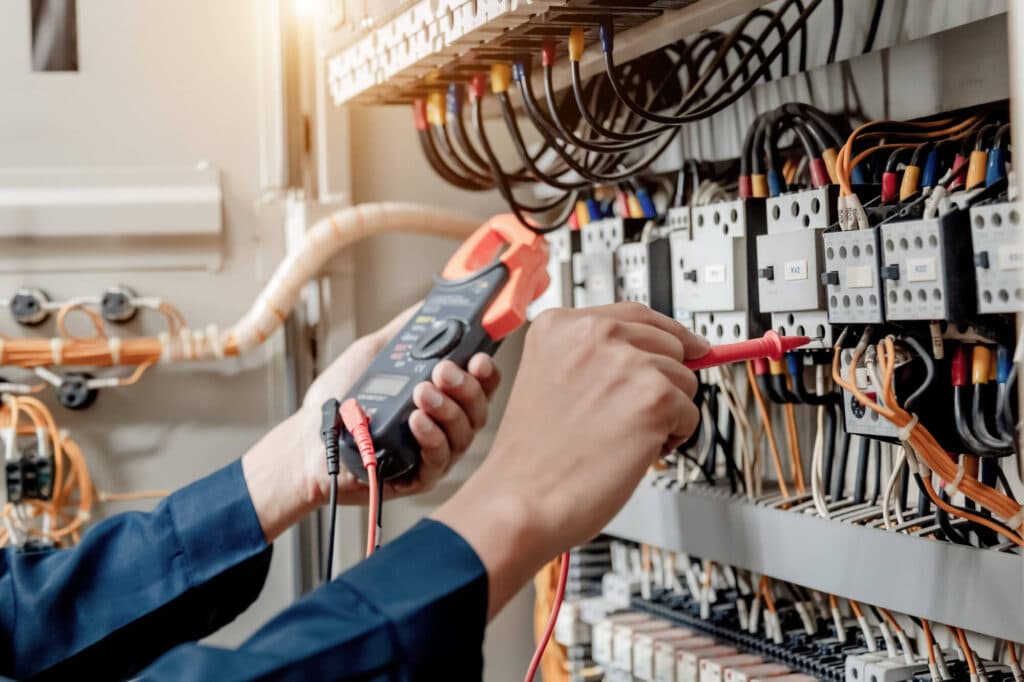
After the visual inspection and inventory, a series of measurements follows. The qualified electrician checks whether the protective measures of the installation work properly. With a suitable measuring device, they measure aspects such as the continuity of protective conductors and the effectiveness of insulation through insulation resistance.
Functional Test
Once the visual inspection and all measurements are completed without significant objections, the functional test follows. The inspecting specialist tests all functions of the inspected item. The focus is on abnormalities during operation. Smoke, shaking, unusual noises or noticeable heat development can be reasons for objection.
DGUV V3 Inspection Report Download
An inspection report helps teams plan and carry out the inspection of devices and operating equipment professionally.
Structure of Inspection Reports
The resulting inspection report summarizes the essential findings of the inspection procedure. To make identification and assignment clear, each report should also include:
- details of inspection steps and results,
- client and contractor,
- location and date,
- inspecting qualified electrician,
- measuring device used,
- and the legal basis for the inspection.
The inspected item is identified in the report by manufacturer, type designation and device number.
For individual inspection points, a checklist format is common. It follows the inspection procedure and provides clear documentation of the process and any abnormalities. Inspection reports also often include an assessment of the severity of detected defects in a final defect report. This gives useful recommendations on whether repair is worthwhile or still possible.
Finally, both the inspector and the client must sign the inspection report so it can be used as an evidentiary document.

Easier Electrical Inspections for Your Company with ToolSense
Spreadsheets are difficult to manage when inspections, deadlines, evidence and defects need to stay traceable. Electrical inspection software such as ToolSense helps digitalize monitoring, maintenance and documentation.
Stay Up to Date with Automatic Reminders
Checking electrical systems can be complex, especially in companies with many devices. ToolSense provides a clear and complete overview of operating equipment so employees can quickly understand what needs attention. Important test dates remain visible, and automatic reminders help ensure that no electrical inspection is missed.

Support Employee Safety
Keeping employees safe when working with machines and electrical devices is a priority. Under DGUV Regulation 3, recurring electrical inspections are required in defined intervals, provided the error rate remains below the relevant threshold. To keep upcoming inspection dates visible, teams can use software with useful checklists for annual electrical inspections.

Save Time and Costs
Depending on the number of assets subject to electrical inspections, companies may face considerable time and cost pressure. ToolSense helps reduce that effort by digitalizing and partly automating DGUV V3 inspection workflows. Efficient workflows and improved work processes help reduce the effort required for electrical inspections on machines.

Transfer and Store Inspection Reports Easily
Inspection documentation is essential for tracing completed electrical inspections. In ToolSense, reports can be stored directly in the lifecycle folder of the relevant device after the inspection, so they remain available whenever needed.

Document and Assess Defects
If defects are found during an electrical inspection, they can be stored together with the inspection reports in the lifecycle folder of the relevant machine. Electricians and specialists then have quick access to the key information and can correct defects faster. This restores both occupational safety and equipment availability.

Optimize Work Processes with Smart Workflows
Efficient workflows help companies reduce time and costs when carrying out electrical inspections. Software can support this by creating work orders directly, assigning them to employees and tracking completion. Responsibilities and work steps remain clear during the job and after completion.

Conclusion: Inspection Reports Prove Fulfillment of the Duty of Care
An inspection report is one of the most important evidentiary documents for companies that use electrical installations and operating equipment. Under DGUV rules, the employer has a duty of care and must ensure that electrical installations in the workplace do not endanger users. If inspections are carried out properly, regularly and with sufficient documentation, this can help avoid costly consequences in the event of damage.
It is therefore essential that inspections are carried out by a competent qualified electrician with additional certification for the correct DIN standard. If an installation is rejected, it must immediately be taken out of use because safety is no longer guaranteed.
Digital tools such as ToolSense make complex inspections easier to plan, document and trace.
Start a Digital Tour
FAQ
What Is an Inspection Report?
An inspection report documents the inspection of electrical equipment by a qualified specialist. It is an important evidentiary document for the employer because it confirms the condition of the inspected installations and devices.
What Must an Inspection Report Contain?
To fulfill its proof function, an inspection report must name the qualified electrician, the measuring device used and the legal basis for the inspection. Each inspected device must also be clearly identifiable by manufacturer, type designation and device number. Measurement data and its evaluation must be documented in an orderly and clear form.
What Types of Inspection Reports Exist?
Reports for the different DIN standards are generally similar because their requirements and conventions overlap. There is no single legally prescribed form, so consistent documentation is especially important. Companies can create their own templates or use professional forms.
Why Are Inspection Reports Created?
An inspection report provides legal certainty. If an accident or damage occurs, the employer can use it to show that an inspection took place and did not reveal defects in the installation. This helps rule out negligence and support claims with the relevant insurer.
Do Privately Used Devices Need to Be Inspected?
For private devices, manufacturer certification is usually sufficient because DGUV rules apply to occupational accidents. Nevertheless, inspection is recommended for devices that have been repaired privately or may pose a fire risk. Companies should also be cautious about allowing employees to bring private electrical devices to work, as liability can become difficult if a defective private device causes injury or fire.