Glossary
An AI agent is software built on a language model that works toward a goal on its own initiative: it plans the steps, uses tools such as business software and databases to gather information or take actions, and checks the results before it reports back. Unlike a chatbot, which answers one message at a time, an agent can carry out a multi-step task within the permissions and approvals people give it.
In Brief
- An AI agent pursues a goal in several steps instead of answering a single question.
- It uses tools: it reads data from connected systems and, if allowed, performs actions in them.
- Agents can work at different levels of autonomy: answering, recommending or acting.
- In facility management, maintenance and fleet operations, typical uses are ticket triage, utilization checks, inspection planning, error-code explanations and daily briefings.
- Safe use depends on guardrails: limited permissions, read-only access first, human approval for actions and a clear audit trail.
What Is an AI Agent?
An AI agent combines three things: a language model that understands instructions in everyday language, access to tools and data, and a loop in which it plans, acts, observes the result and decides on the next step. You give it a goal, for example "find out which sites need attention today", rather than a fixed script. The agent works out which information it needs, fetches it, combines it and returns an answer or a proposed action.
You usually describe the job to an agent the way you would brief a new colleague: its role, which systems it may look at, what it should deliver and when.
AI Agent vs. Chatbot vs. AI Assistant
The terms overlap, but the differences matter in practice:
- Chatbotanswers messages in a conversation, often from a fixed knowledge base or set of rules. It does not usually act in other systems.
- AI assistanta general-purpose model such as Claude, ChatGPT or Microsoft Copilot that helps a person with questions and tasks. It works when you ask it something.
- AI agentgoal-directed. It breaks a task into steps, calls tools, works with live data and can continue until the goal is reached, under human oversight.
Many AI assistants can now act as agents once they are connected to tools and allowed to use them.
How AI Agents Use Tools and Data
An agent is only as useful as the systems it can reach. It connects to them through interfaces such as APIs or connectors. A common standard for this is MCP (Model Context Protocol), an open protocol that lets AI assistants connect to business software in a uniform way. Through such a connector, an agent can search records, read details and, where permitted, create or update entries.
The connector also defines the limits: which data the agent may see, whether it may only read or also write, and under whose identity it acts.
Levels of Autonomy
AI agents can be given more or less freedom. A practical way to think about it is in three levels:
- 1Answeringthe agent reads data and answers questions. People decide and act.
- 2Recommendingthe agent proposes a next step, such as moving an idle machine or combining inspections into one visit. A person approves or rejects it.
- 3Actingthe agent carries out defined actions itself, such as opening a ticket, within clear rules and with a record of what it did.
Most organizations start at the first level and expand step by step as trust and controls grow.
How AI Agents Are Used in Facility Management, Maintenance and Fleets
Typical use cases include:
- Ticket triagesorting incoming fault reports by urgency, site and asset, and flagging reports that have been untouched for days.
- Finding idle machines before buying newcomparing utilization across sites to check whether existing equipment can cover a need before new capital expenditure is approved.
- Scheduling inspectionslisting checks that are due or overdue and grouping them by site so a technician can handle them in one visit.
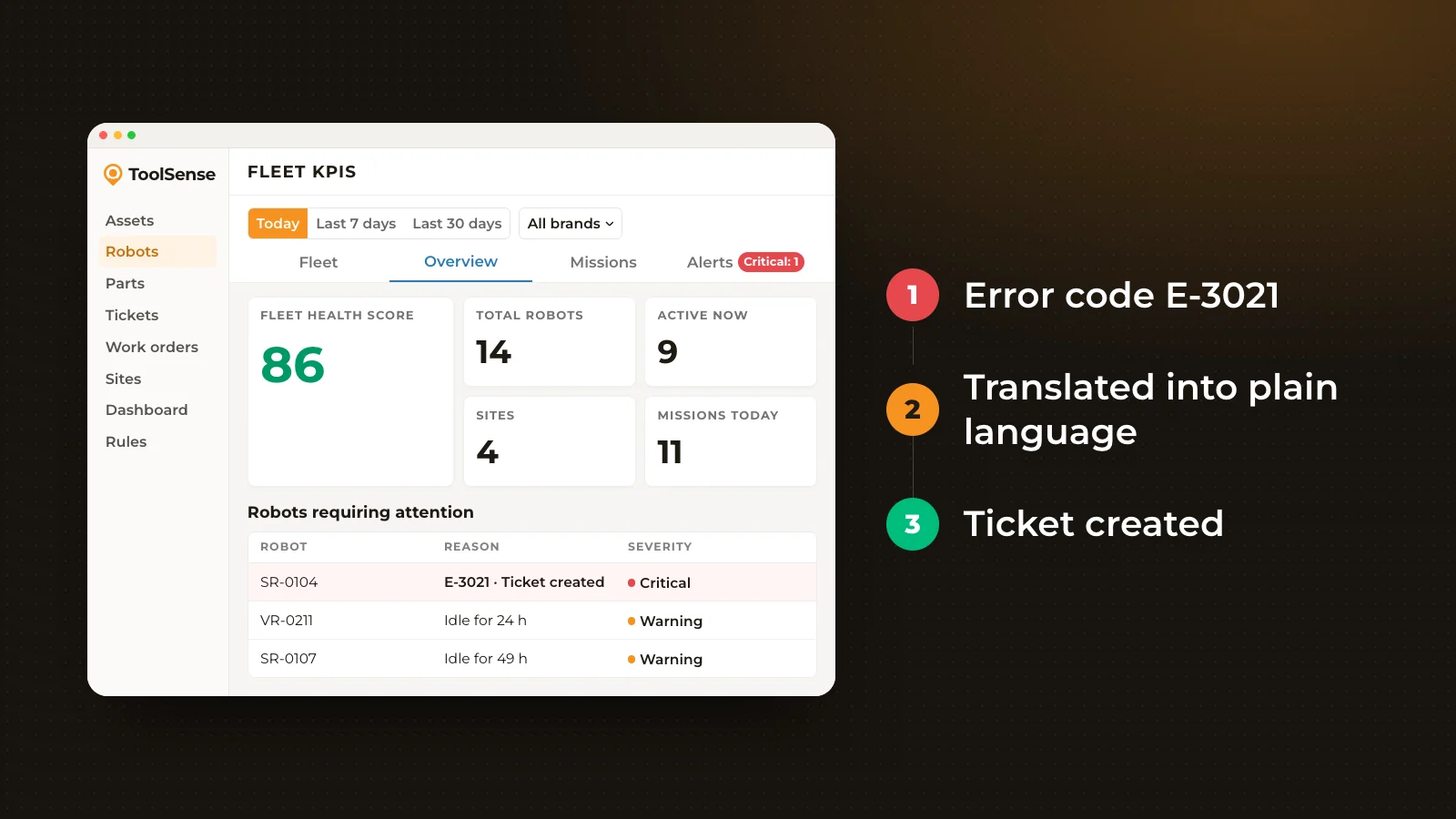
- Translating error codesturning a machine or robot error code into a plain-language explanation with the likely next step.
- Briefingspreparing a daily or weekly summary of what needs attention, what has changed and what is due.
Risks and Guardrails
AI agents work with company data and, in some setups, can change it. Sensible guardrails include:
- Permissionsthe agent should see and do only what the person using it is allowed to see and do.
- Read-only firststart with reading and answering before allowing any write access.
- Human approvalrequire a person to confirm actions that change data, cost money or affect safety.
- Audit trailrecord which actions were taken, when and on whose behalf.
- Data protectioncheck which data the AI provider processes, how long it is retained and whether it is used for model training, and align this with your data protection rules.
- Verificationlanguage models can make mistakes, so important answers should be checked against the source record.
AI Agents at ToolSense
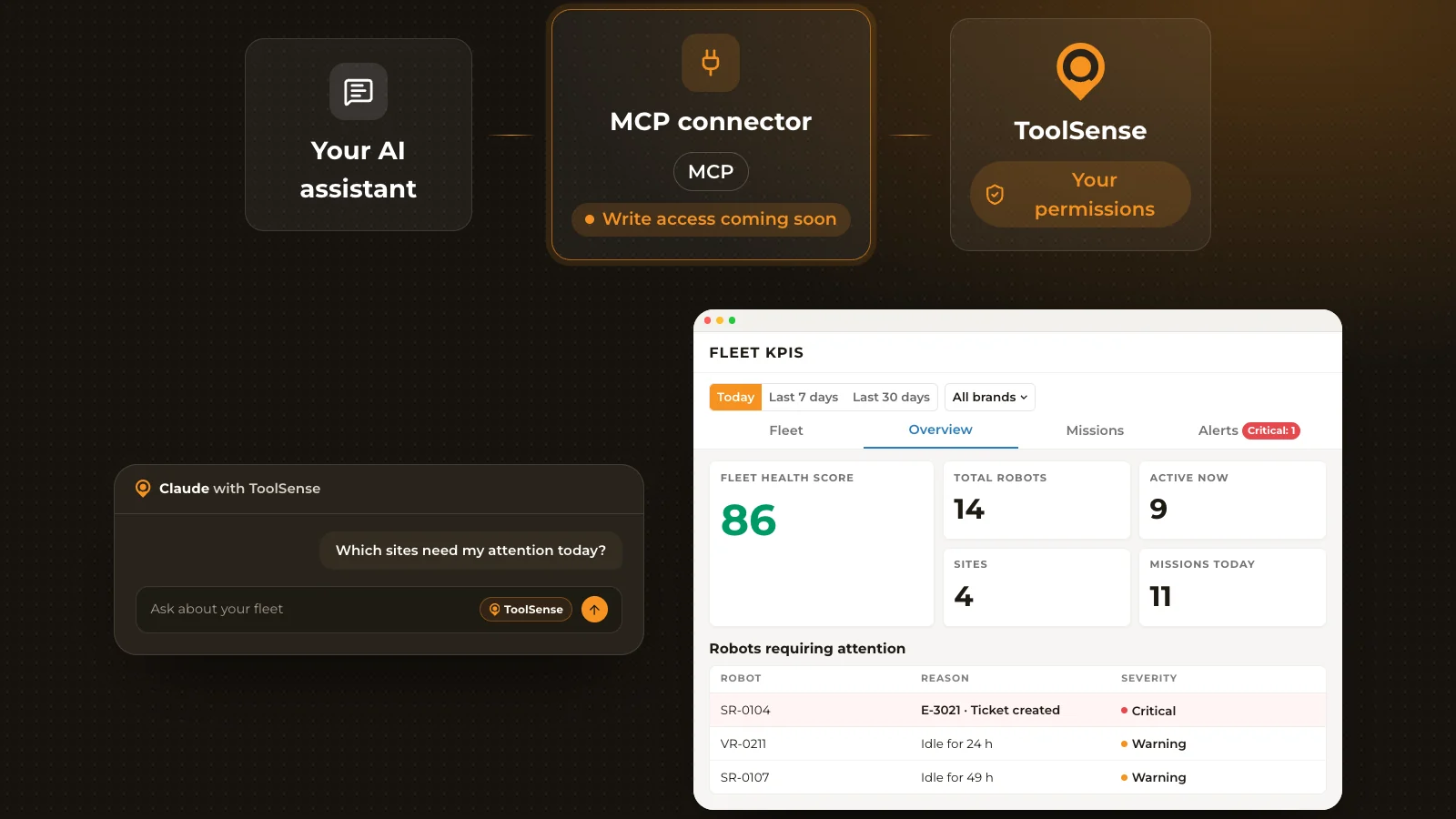
Today, Just ask lets teams ask Claude, ChatGPT or Microsoft Copilot about their live ToolSense data, such as machines, sites, tickets, work orders and inspections, in their own words. The ToolSense connector is built on MCP. It is read-only today, and write access is coming soon. Everyone signs in with their own ToolSense account and sees only what their ToolSense permissions allow. Details for IT and data protection teams are on the Just ask security page.
Two further AI features are coming: the AI Fleet Assistant, which checks whether idle machines elsewhere can cover a need before new capex is signed off, and the AI Support Manager, which answers from a machine’s own manual, IoT data and service history when it stops and opens a ticket if a technician is needed.
FAQ
What is an AI agent in simple terms?
An AI agent is software that receives a goal, plans the steps to reach it, uses tools and data along the way and reports the result. It does more than answer a single question.
What is the difference between an AI agent and a chatbot?
A chatbot answers messages in a conversation. An AI agent pursues a goal across several steps, calls tools, works with live data from connected systems and can take actions if it is allowed to.
Can AI agents act on their own?
They can, if they are given that permission. In practice, most organizations start with agents that only read and answer, then allow recommendations and finally defined actions with human approval and an audit trail.
Are AI agents safe to use with company data?
They can be used safely with the right guardrails: access limited to the user’s own permissions, read-only access to start, human approval for changes, a record of actions and a review of how the AI provider handles and retains data.
How are AI agents used in facility management?
Common uses are triaging tickets, finding idle machines before buying new ones, planning due inspections, explaining machine error codes and preparing daily briefings on what needs attention across sites.