Equipment Management
If your company runs several assets and important pieces of equipment, solid asset management is the only way to keep an overview. How many assets do you own? What are they worth, and what do they cost you? How often did each one get repaired last year, and which machine caused the longest downtime? If those answers don’t come to you quickly, your asset management strategy needs work.
This article explains what an asset management strategy is and how to build a workable asset management policy for your business. With one in place, you understand your equipment far better and pick up all the benefits that come with asset management. If you would like to estimate the impact first, our pricing page outlines how ToolSense scales to your fleet of assets.
Key Takeaways
- An asset management plan is a strategic approach to your company’s asset management.
- Asset management aims to increase your company’s profitability and productivity by reducing downtime and repair costs through preventive maintenance.
- Your asset management strategy should be based on the types of assets your company operates and your company’s individual needs and objectives.
- A software asset management strategy or asset management system can improve your management plan and keep track of your most important equipment for you.
What Is an Asset Management Strategy?
Start with the word “assets.” For your business, an asset is any resource of economic value, and it can be material or immaterial. Intangible assets include things like licences or patents. Tangible ones cover land, buildings, office supplies, vehicles, machines, and other equipment. Asset management, sometimes called wealth management, is the process of planning, acquiring, managing, maintaining, tracking, and disposing of those assets across the asset’s entire lifecycle. The point of all this is to grow the company’s wealth, productivity, and profitability.
What Is Strategic Asset Management (SAMP)?
To maximise success and cut the risks tied to your equipment, you need a strategy your business and your employees can actually follow. Strategic asset management, or SAMP, builds a framework for managing your assets over the long term rather than chasing short-term needs and budgets. If you have a vision for where the company should be in 5, 10, or 20 years, your strategic asset management should reflect those goals.
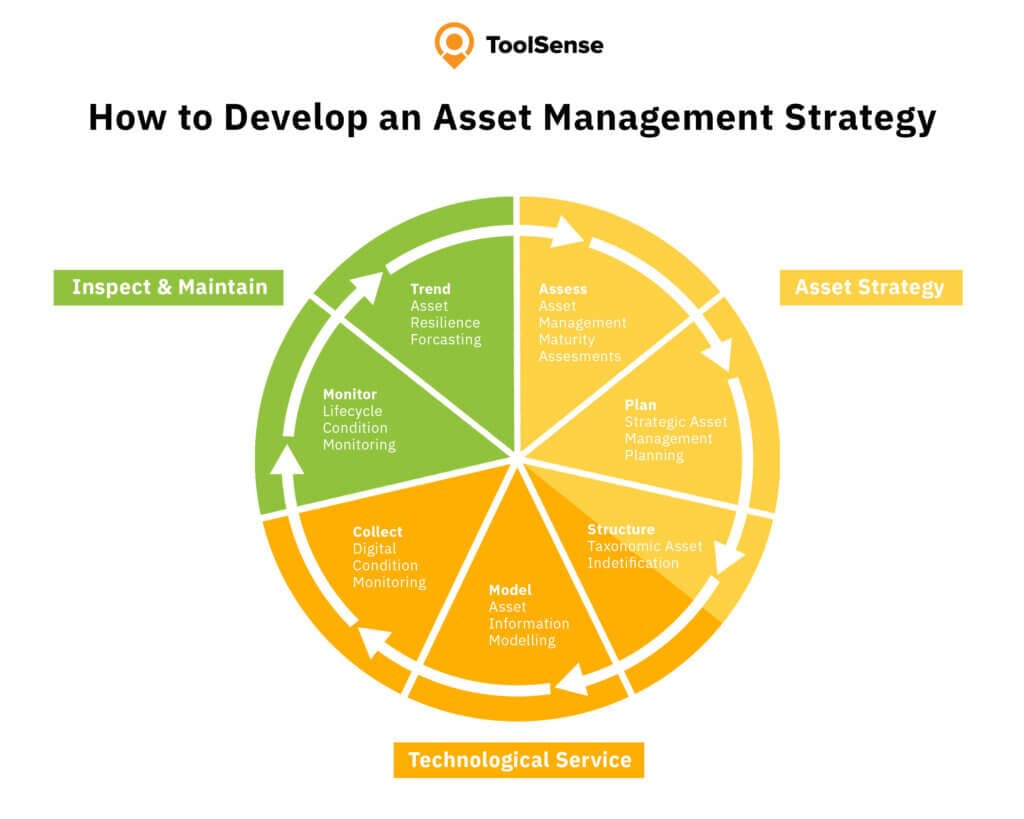
The Asset Management Strategy Development Process
Determine Critical Assets and Equipment
Which assets would hurt your business most if they failed or went down? When an outage or breakdown would seriously dent your output, that piece of equipment is critical. The instinct is often to label every asset important, but that just drops you back to square one on determining your critical asset. “If everything is important, then nothing is,” said Patrick Lencioni. So your company first needs a criticality assignment process and ranking system built around your own core criteria — your mission, your values — to work out which assets genuinely qualify as critical.
Prioritise Your Assets
With the right criteria set and a criticality process in place, it’s time to rank and prioritise. Your priority assets aren’t always the ones in heaviest use; they’re the ones your production process can least afford to lose. Prioritising also means studying the statistics. How much downtime does a given machine cause? How often does it need repair? Which maintenance tasks come up most, and what do they cost? How does the asset affect throughput? A good risk management plan lets you trace the root of recurring problems, cut downtime, and lower the maintenance cost of your critical assets.
Develop an Asset Management Plan
There are several flavours of asset management strategy, from digital asset management to financial asset management. The one you build depends on your company and the assets you intend to manage. Begin by setting your objectives. Do you want to increase productivity, reduce downtime, or run more cost-efficiently? Those goals, together with the asset types in scope, form the foundation of your strategic asset management. A solid plan names your prioritised equipment, the resources required, the time each asset will demand, and who owns which area. It should also spell out how you’ll capture your wins, the improvements you put in place, and the results.
Support and Buy-In for the Asset Management Program
Asset management is a team effort, so bring your staff into any strategy you want to see stick. Machine operators, technicians, foremen, and managers all need to be in the loop. Operators and technicians usually know the assets best; foremen and managers need to understand the procedures so they can plan and organise daily workflows around them. Once you communicate your objectives and show employees how they benefit too, everyone can pull in the same direction to put the plan into practice.
Evaluate Data
A real advantage of a strategic plan is the data it generates. Depending on your assets and your approach, that can include runtime, downtime, GPS coordinates and travelled distances, repair requests, work orders, and maintenance costs. The data you already hold points you in a direction before you even roll the strategy out. By reviewing existing procedures and logging breakdowns, repairs, and their costs, you’ll know where to start and how to sharpen your asset management over time.
Review and Revise the Asset and Maintenance Strategy
You are probably already running some kind of maintenance strategy, often without realising it. When a company says it has no strategy, that strategy is usually corrective or reactive maintenance — waiting for an asset to break before fixing it. If that describes you, or if you’ve been using another approach, now is the moment to review how well it actually held down downtime and costs. The years of data you’ve gathered let you build statistics that show where to improve, for instance by shifting to preventive or predictive maintenance.

Have the Right People Available
Even the best strategy only works when the whole team is on the same page. Consult your employees while you’re still developing the plan, because operators and technicians know the assets inside out. They’re exactly the people you want at the table. And if you run a large company with a sprawling asset base, hiring an asset manager to oversee the rollout will make implementation far smoother.
Monitor and Communicate Your Results
No strategy, however good, delivers results overnight. This is a long-term play that takes months to pay off, and both you and your team should know that going in to keep expectations grounded. Early on, a new approach can even look like it costs more time and money — say so plainly to your operators and technicians if you want them on board for the long haul. Analytics tools help you track your wins, surface the areas already paying off, and flag what still needs work. Watching how the new strategy moves downtime and repair costs over time is the clearest signal of whether it’s working.

Using the ISO 55000 for Creating a Strategic Asset Management Plan
According to ISO 55000, a strategic asset management plan includes “documented information that specifies how organisational objectives are to be converted into asset management objectives, the approach for developing asset management plans, and the role of the asset management system in supporting achievement of the asset management objectives”. In other words, how your assets get managed matters more than what gets managed. When you develop a strategy along ISO 55000 lines, work through those details and write them down in your plan.
Benefits of Strategic Asset Management
Still weighing whether a new strategy is worth the effort? Here is what a strategic asset management plan tends to deliver:
1. Boost Productivity and Profitability
Good asset management surfaces the bottlenecks that drag down your whole production process. It also heads off unexpected downtime and drawn-out repairs, keeping machines in top shape and the workflow smooth — which feeds directly into productivity and profit.
2. Improve Customer Satisfaction
That same smooth workflow reaches your customers and helps cut complaints. When the production line just runs as it should, you can put more attention on customer support and meet demand faster.
3. Reduce Repair Costs
Preventive maintenance
belongs at the centre of any asset management strategy, keeping equipment in the best possible shape. Service your machines at regular intervals and breakdowns grow less likely, sparing you the longer, pricier repairs.
4. Plan More Easily
Knowing which assets you own, how the asset lifecycle works, and whether you need new acquisitions makes planning ahead far simpler. Analysing the data shows how efficient you really are, which machines are nearing replacement, and where an extra asset would pay off down the line.
The Role of EAM & CMMS Software
An asset management system or software can take your asset management a long way. Enterprise Asset Management (EAM) software or a Computerised Maintenance Management System (CMMS) like ToolSense keeps tabs on your assets for you. You can fold existing equipment into the platform with a simple Excel import and start tracking runtimes, breakdowns, repairs, or GPS coordinates in a few steps.
ToolSense brings asset management, maintenance management, and work order management together in one platform that any employee can pick up after a short introduction. It’s cloud-based and fully mobile, so operators, drivers, managers, and office staff can work from anywhere, while the analytics tools surface the data your decisions depend on. You can also store images, videos, invoices, custom checklists, and warranty details in each asset’s lifecycle folder, keeping the important information in one place that’s easy to reach. A software-led strategy is simply the modern way to manage assets.
Practice Examples from Facility Management
Customer stories show that the best asset strategies usually start with a practical data foundation, not with a complex framework. In the Breer Gebäudedienste story, the team moved away from an incomplete Excel-based asset list and toward central, mobile-accessible machine data. That made the asset register useful for both management and people working on site.
At ISS Austria, around 6,500 cleaning machines were already documented in a central database before telemetry, GPS, low-power sensors and Bluetooth data were added step by step. The lesson for an asset management strategy is simple: first create a reliable master record, then enrich critical assets with operating data where it improves maintenance, compliance or service quality.
The 2M-Gruppe shows why strategy should also include cost visibility. By tracking age, condition, DGUV-V3 inspection status, location and repair history, the team could identify hidden cost drivers and decide whether an asset should be repaired, replaced or redistributed.
How ToolSense Improves Your Asset Management
Conclusion
Strategic asset management is what lets you get the most out of your equipment and keep it running smoothly across its whole lifecycle. The upfront cost in time and money is real, but a good plan saves far more in the long run. If your goal is a smooth workflow, less machine downtime, and higher productivity, an asset management plan gets you there. Our ROI calculator dives deep into your current processes & calculates how much you could save with the ToolSense Asset Operations Platform.
FAQ
What Is an Asset Management Strategy?
An asset management strategy describes the strategic approach to asset management within a company. It includes acquisition, planning, maintenance, and the production process.
What Is Asset Strategy Management?
Asset strategic management within a business is the strategic approach to purchasing, planning, and maintaining all its assets.
What Is an Asset Management Policy?
A company’s asset management policy is a documented scheme that involves the acquisition, planning, and maintenance of all its assets.
What Is a Strategic Asset Management Plan?
A documented plan of all of a company’s assets, their acquisition, planning, maintenance, and use during the production process is called a strategic asset management plan.
How to Improve Asset Management?
You can improve your company’s asset management by employing a dedicated asset manager and utilising asset management software like ToolSense that will keep track of all your assets for you.