
Glossary
Mean Time to Failure (MTTF) is a reliability metric that turns up across aerospace, construction, automotive, manufacturing, and electronics. This post defines MTTF, shows how to calculate it, walks through how different industries use it, and connects it to the metrics it sits next to: Mean Time Between Failures (MTBF), Mean Time to Repair (MTTR), and Availability. It also covers why MTTF matters for tightening maintenance schedules and cutting downtime, and where an asset management solution like ToolSense fits in.

Key Facts
- MTTF is an important reliability metric, along with MTBF (Mean Time Between Failures) and MTTR (Mean Time To Repair).
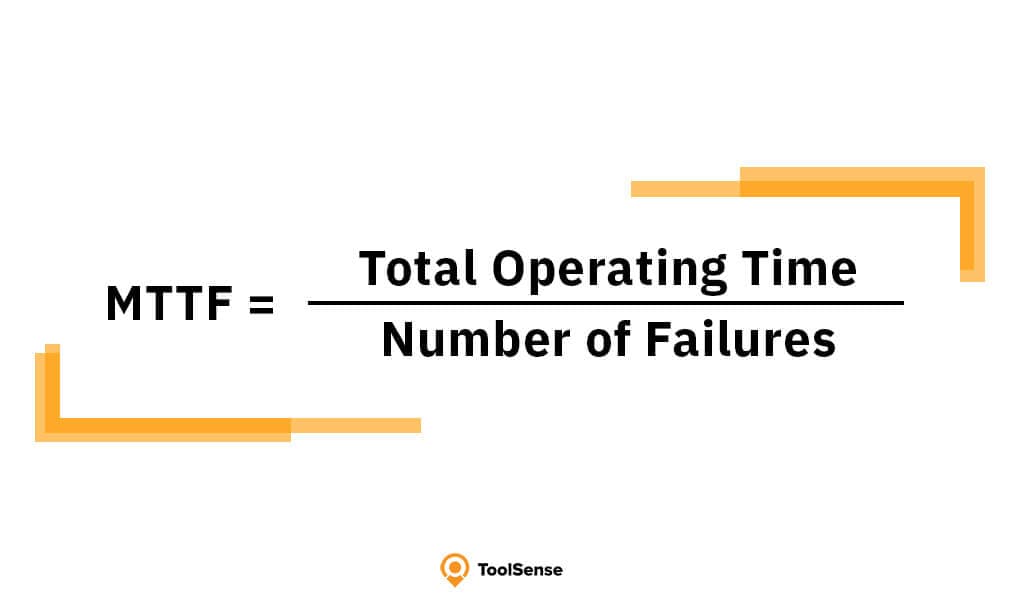
- Mean Time To Failure is calculated by dividing the total operating time by the number of failures.
- Tracking and improving important reliability metrics such as MTTF can help a company increase an asset’s lifespan, boost productivity and profitability, as well as reduce maintenance costs.
- ToolSense’s asset management solution can be used to automatically track and collect important data to improve not just MTTR, but the entire asset management strategy.
What Is Mean Time to Failure (MTTF)?
Mean Time to Failure (MTTF) is the average time a non-repairable system runs before it fails. It gives reliability analysis a hard number: how long you can expect such a system to keep working. The math is simple — divide the total operating time by the number of failures over that period.
Situations When Calculating MTTF Can Help Improve an Organisation’s Asset Management Strategy
A few decisions get noticeably easier once you know an asset's MTTF. Purchasing is the obvious one. Compare two products and the one with the longer MTTF likely has a longer asset lifespan, which can make it the cheaper option over time even at a higher sticker price.
Maintenance scheduling is the second. Knowing roughly when a product tends to fail lets you intervene before it does. If an asset's MTTF is 500 hours, scheduling maintenance every 400 hours buys a margin against unexpected downtime.
It also feeds inventory management. Products with a short MTTF burn through stock faster, so it pays to hold more of them on hand and avoid stockouts.

How to Calculate Mean Time to Failure?
Calculating MTTF starts with the data: you need to track maintenance metrics and record the operating time and failure rate of the product or system. The formula is:
A couple of caveats come with it. MTTF assumes failures are independent and identically distributed, which isn't always true in practice. It also says nothing about how severe a failure is or what it costs you — Mean Time To Dangerous Failure is a separate metric and can look very different from general MTTF.
MTTF Calculation Example
Take a system that runs for 500 hours and fails 4 times in that window. The equation works out like this:
MTTF = Total operating time / Number of failures MTTF = 500 / 4So this system has a Mean Time To Failure of 125.
MTTF: Industry Examples
Different sectors lean on MTTF for product reliability and maintenance planning in their own way. Aerospace uses it to estimate the product lifespan of aircraft components and time maintenance accordingly. The automotive industry applies it to gauge the reliability of car parts and feed improvements back into design and manufacturing. In electronics, it estimates how long computer components will last. The common thread: any company trying to reduce unplanned downtime, head off asset failure, and rein in maintenance costs can use MTTF to sharpen its preventive maintenance schedules and anticipate system failures.

Related Concepts: Mean Time Between Failures (MTBF), Mean Time to Repair (MTTR), and Availability
MTTF rarely travels alone. It sits alongside other reliability metrics like Mean Time Between Failures (MTBF) and Mean Time to Repair (MTTR), plus Availability. MTBF is the average time between failures; MTTR is the average time it takes to repair a failed product or system; Availability is the share of time a product or system is ready to use. Together they give you a fuller picture of system reliability and where maintenance procedures can improve.
Importance of MTTF and How ToolSense Can Help
Get MTTF right and the downstream effects compound: tighter maintenance schedules, less downtime, more reliable products, and over time, higher productivity and profitability. None of that happens without the data behind it. Asset management software like ToolSense handles real-time monitoring, predictive maintenance, and automated alerts. Runtime, equipment downtime, maintenance history, and work orders are collected automatically and surfaced as analytics on a customisable dashboard, so maintenance teams have what they need, whenever they need it.
How to Improve MTTF
Better MTTF means less downtime and more reliable assets, which feeds straight into productivity and profitability. Three levers do most of the work.
1. Purchase quality materials and parts
Durable, well-made materials and parts last longer, full stop. They often cost more up front, but a higher MTTF and a lower risk of failure usually justify the spend over the life of the asset.
2. Use assets only for intended functions
Misuse and overuse accelerate wear and drag MTTF down. Make sure people are trained to operate non-repairable assets the way they were designed to be operated.
3. Implement an effective preventive maintenance program
A solid preventive maintenance programme catches small issues before they become failures. Regular maintenance cuts downtime, extends asset lifespan, and spares you the cost of emergency repairs and early replacements.
Conclusion
MTTF is one of the core numbers behind product reliability and asset management. Knowing how to calculate it, where industries apply it, and how it relates to MTBF, MTTR, and Availability gives teams a real basis for tighter maintenance schedules and less downtime — and, with that, stronger productivity and profitability.
As a quantitative measure of reliability, MTTF helps estimate how long assets and systems will last. Tracking it alongside other reliability metrics sharpens asset management and trims maintenance costs, and a platform like ToolSense automates the maintenance processes that keep those numbers moving in the right direction.
FAQ
What is the difference between Mean Time to Failure (MTTF) and Mean Time Between Failures (MTBF)?
Mean Time To Failure measures the reliability of non-repairable assets, whereas Mean Time Between Failures is used for both repairable and non-repairable systems.
How is Mean Time to Failure (MTTF) calculated?
Mean Time To Failure (MTTF) is calculated by dividing the total operating hours by the number of failures experienced during that time.
How can Mean Time to Failure (MTTF) be used to improve product reliability?
Identifying the MTTR values for commonly used systems can help companies make more informed decisions in the future by choosing higher-quality equipment with a longer lifespan. Additionally, MTTF can help predict system failures and ensure maintenance tasks are carried out before a failure occurs and results in unplanned downtime.
What are the limitations of Mean Time to Failure (MTTF)?
Mean Time To Failure calculates the average lifespan of a non-repairable asset, meaning the average time a system runs without failure. However, the average MTTF can deviate from the actual MTTF of an individual system, which leads to a system being replaced too soon or failure occurring before the MTTF is up. For example, the average lifespan of an LED lightbulb is 50,000 hours, but individual lightbulbs might break sooner or last much longer.
How can Mean Time to Failure (MTTF) be used to optimise maintenance schedules?
MTTF can help companies predict system failures and prevent them by replacing non-repairable systems just in time before their failure leads to equipment downtime.