Glossary
Understanding the Total Cost of Ownership – an Example
What does total cost of ownership mean to anyone running a business or an enterprise? When companies make a purchase, this concept tends to get left out. People focus on the buying price they see on the tag, and stop there.
Take a simple case: an office is buying a printer. You settle on your favourite model and pay the price the supplier asks. That figure is the purchasing price. But it is not the whole story. The printer still has to get from the supplier's store to the office, and that is extra cost number one: transportation. You incur it the moment the printer becomes yours.

Hidden Extra Costs
The printer reaches your office and sits on your desk. The first thing you do is power it on, so you look for the nearest wall socket, plug it in, and admire your new purchase. Extra cost number two has just checked in: the electricity to run it. And before you print a single document, you remember you need paper. Off you go to the stationery section for a ream or two.
That is extra cost number three. A few months and a lot of printing later, the printer runs out of ink, so you replace the cartridges. Extra cost number four has now secured a permanent slot in the month's office expenses. Then there is maintenance, which you will be footing along the way too.
Sit down and add it up, and you have already spent more on this printer than you planned. Your original budget was around €200 for the purchase. The item in front of you cost considerably more.
KEY TAKEAWAYS
- The total cost of ownership (TCO) is made up of the purchase price of a particular asset and the operating costs over its lifetime.
- Businesses use TCO as a means of analysing financial statements. Individuals use TCO to evaluate potential purchases.
- Looking at TCO is one way to assess the long-term value of a purchase to a business or individual.
- Understanding the recurring costs behind TCO also helps when comparing software pricing and other subscription-based tools.
What Is the Total Cost of Ownership?
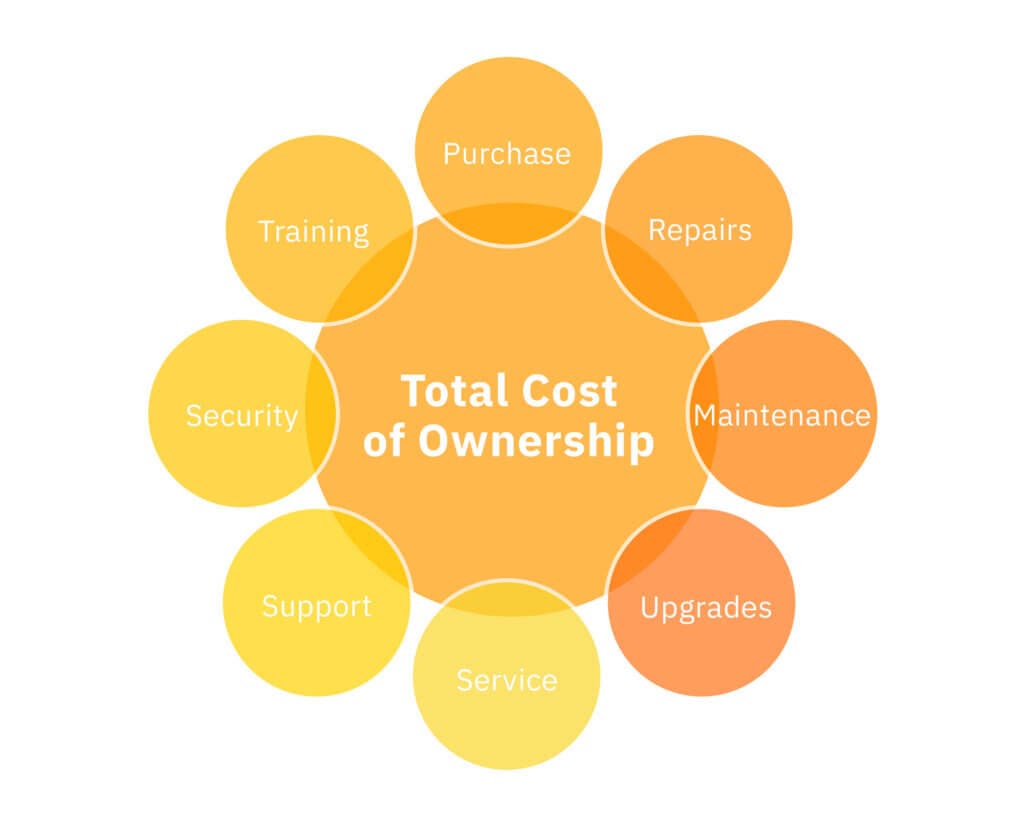
TCO works like an iceberg. The buying price is what catches your eye, and it is a short-term cost. What you don't see are the long-term costs underneath: upgrades, plus the time spent upgrading software and hardware. The tip of the iceberg is the purchase price; the rest of the expenses make up the enormous mass below the surface. Frame a purchase this way and you get a far broader perspective on what you are actually signing up for.
TCO analysis is especially relevant in IT. So we can define it as an in-depth comparison between the short-term and long-term costs you are likely to face before, during, and after acquiring an item, property, or asset. Put another way, it is the acquisition price plus the operational costs you incur down the line.
The History Behind TCO
The idea took shape in the mid-80s, when operational managers in the ICT industries began flagging the enormous costs that landed on them after they bought hardware and software. To keep these freshly acquired assets running smoothly, many companies found they were paying 5 to 8 times the acquisition value in support. In nearly every case, the purchase price looked small next to the maintenance bill.
This kind of analysis helps decision-makers in several ways. A TCO study can inform a major lease-versus-buy call. Factored into the purchasing process, it shapes vendor selection, the prioritising of capital acquisitions, and overall corporate budgeting.
TCO in IT Companies
In an IT setup, new hardware or a software upgrade can cost a company a small fortune. When such a purchase is on the table, TCO is the yardstick. The real question is whether the value the company gains exceeds the total cost of operating that hardware or software.
A TCO analysis forces a few questions before you commit. What resources do you need to operate the new system? Will you have to train staff to use it? Are there licence fees to buy? What about installation?
How much would it cost to migrate from the legacy option to the new one? If something breaks, what is the financial hit? And how much to put the most secure measures in place to prevent data loss?
When something unfamiliar arrives, whether hardware or software, the people using it have to climb the learning curve. That takes time, effort, and money. The list keeps going.
In time, firms started outsourcing services that were cheaper and easier to run than building them in-house. Cloud hosting, for instance, turned out to be far simpler to adopt than a physical on-site server.
TCO Software Programs
Cloud providers charge a monthly fee that usually bundles in technical support for when something needs debugging. The cloud removed some cost drivers, yet pinning down total cost of ownership remains a complicated exercise.
Software acquisition has changed too. In the past you bought a program and used it until it went obsolete. Today, companies sell software on a subscription basis.
To keep clients on board, those vendors ship feature updates regularly. The strategy works: most companies want the latest tools to get the best out of their teams, so they keep paying for subscriptions that come with the newest updates and features.
What Is the Objective of Calculating TCO in IT?
IT companies use this method to surface every expense incurred before, during, and after buying a product. It plays a real role in accounting, since it makes the profits and losses along the way visible.
Total Cost of Acquisition Example in IT
Picture a company buying a new computer system to run its operations. The system carries a purchase price, which is the initial outlay. Then the other factors arrive: new software needed to run it, installation and transition costs, staff training, and security measures to match the new system.
The biggest recurring cost is maintenance, which comes around often to keep up with updates and the like. Individuals weigh the whole cost of ownership even on smaller purchases. It is easy to overlook, but fixating on the immediate direct cost can quietly set up future losses.

Points to Note When Making Purchases in IT
Before you buy in IT, ask what extra hardware or software the purchase will pull in alongside it. Think about the maintenance and service costs that show up over time, which can mean frequent software updates or full upgrades. Then there is administration. Will you need to hire someone with the right skills to run the system, or train the staff you already have?
Calculating the Total Cost of Ownership When Buying a Car
If you are buying a car, total cost of ownership is a metric worth your attention. It is essentially the sum of what the vehicle will cost you to own and operate over time. Plenty of people assume the sticker price is the answer. It isn't, because it leaves out everything from fuel to parking fees.
TCO accounts for the initial purchase price alongside fuel costs, insurance, and maintenance. Together those numbers help buyers make a more informed choice about which car to put in the driveway.
Use this as your guide and you can work out the total cost of ownership for any car, new or used. Every car depreciates, and some depreciate faster than others.
TCO Calculation
The hidden costs of ownership vary with the car you pick. Some models cost more to insure than others. Lease the vehicle and you will likely pay a monthly charge on top of the initial payment, and you may be on the hook for excess wear, tear, or damage beyond everyday use. Finance it instead of paying cash and you make monthly payments until the loan clears, which stacks up the costs further.
Dealers know most buyers like to pay in monthly instalments, which is why they list the MSRP (Manufacturer's Suggested Retail Price) on auto loans. Even if you can pay cash, the other costs of buying a car don't disappear. If you plan to finance or lease your next vehicle, the points below cover what you need to calculate total cost of ownership on a new or used car.
When buying a car, consumers have to look at the full cost of ownership. That means the purchase price plus maintenance, parking fees, insurance, and fuel.
People weighing a new car against a used one need this analysis to make the call, because it captures the total cost across the vehicle's lifetime rather than the purchase price alone. Over the life of both vehicles, it pays to weigh fuel consumption, maintenance, repair costs, insurance, and registration payments.
The Pros and Cons of TCO
Pros
- TCO provides an earlier view on costs that were not anticipated when during purchase planning.
- Furthermore, it helps provide helpful financial information in any industry, not just IT.
- Total Cost of Ownership provides room for companies to be able to do proper budgeting.
Cons
- TCO provides comparison of financial implications only.
- It discourages project prioritization. You get to work with something that doesn’t have huge financial implications, not considering urgency or importance.
- Total Cost of Ownership encourages cheaper purchases, not the impact a purchase will add to the organization.
How ToolSense Reporting & Analytics Improve Your Asset Management
Conclusion
Total cost of ownership gives you a clear picture of what something actually costs. It looks well past the original price and hands a company the information it needs to make a purchasing decision. TCO is rarely the only lens you should use when comparing solutions, but it is a fundamental one.
At its core, TCO takes a financial approach to acquiring a product. Fifteen years ago, Gartner, a US technology company, introduced a related methodology called total value of ownership (TVO), which pushes businesses to weigh other factors such as sustainability and growth in their decisions. The model mirrors TCO but also accounts for non-monetary benefits.
FAQ
What Do You Mean by Total Cost of Ownership?
TCO aims to analyse the actual cost of an asset, beyond the basic purchase price but include the costs of operation.
What Is the Total Cost of Ownership With Example?
A company wants to purchase a new computer system to run its operations. The computer system already has a purchase price. Then comes some other factors like getting new software products, installation and transitional costs. Staff would need to be trained for the new system, and new security measures would need to be implemented to match the new system.
How Do You Calculate Total Cost of Ownership?
When buying a car, the total cost of ownership is a metric that considers the initial purchase price and other factors such as fuel costs, insurance costs, and maintenance costs. There are various hidden costs that need to be considered.
Why Is the Total Cost of Ownership TCO Important?
It is important because it provides a clear picture of the actual expenses and offers firms important information to make purchasing decisions.